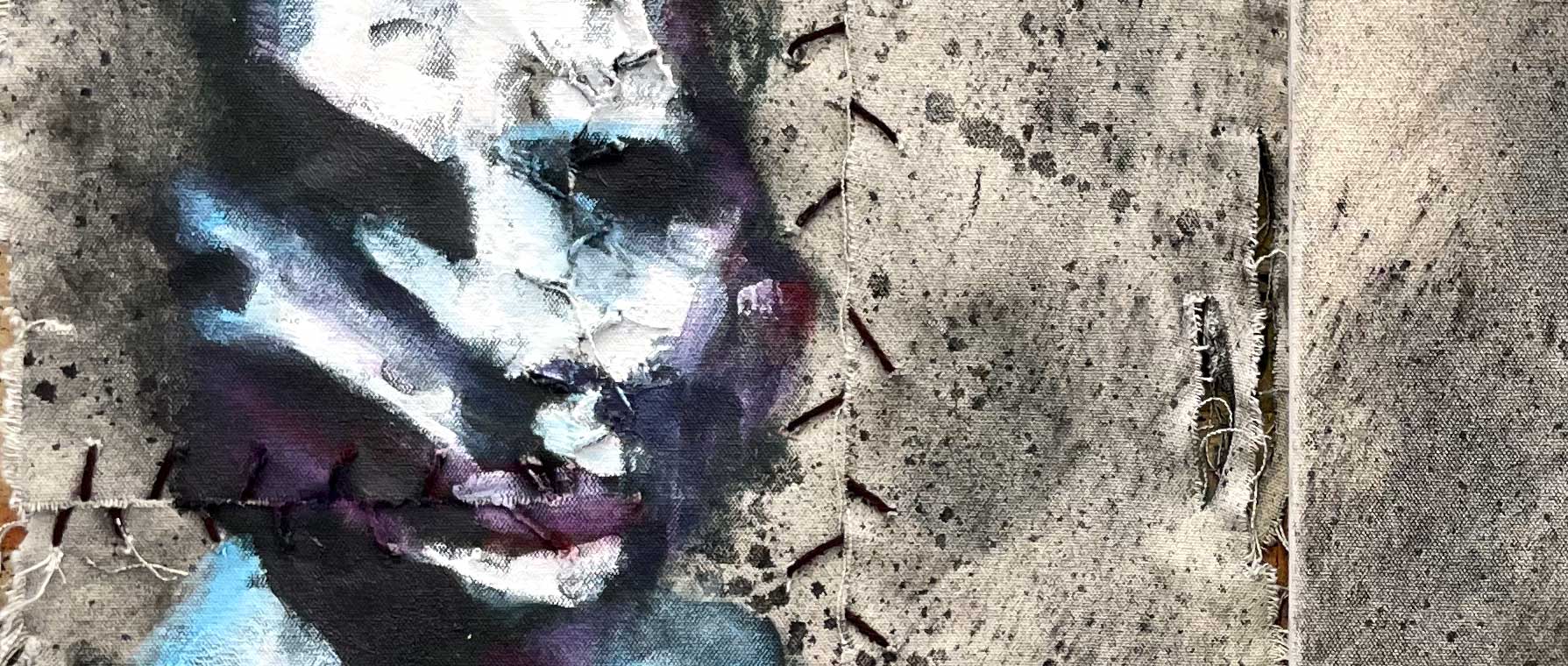
29
May
29 May - Melbourne, Australia.
Image: Duplex (detail), 2026, Back‑to‑back double‑sided painting: rabbit‑skin–sized canvas, charcoal, oil paint, woollen yarn, wire, rusted nail, double‑sided tape, rusted and new bulldog clips, reclaimed wooden frame.
Philosophy is largely a written and verbal discipline exploring who we are as human beings. It is therefore interesting to examine how visual art, like the challenging installation and sculptural work of Berlinde de Bruyckere, explores similar concepts to Sartre’s writings about existentialism. In Existentialism is a Humanism, Sartre argues (Sartre et al. 2007:24) that when we choose for ourselves, we “choose for all”. In this way, every decision we make holds up an image of what a human being could be, which is foundational to the existentialist concept of freedom and bad faith. Alongside freedom, Sartre describes bad faith as the attempt to flee responsibility by pretending our freedom, or its consequences, do not exist. Investigating visual art within this existentialist framework opens a dialogue that asks are artworks a portal into an artists shared world or a private confession? De Bruyckere’s statement (De Bruyckere 2012, cited in Bunyan 2012) that “it makes it easier if we take care of each other and if we have a language with each other to communicate about pain, suffering and fear” can be read in terms of Sartrean freedom and an artist’s refusal of bad faith, a commitment to being true to uncomfortable truths. In her 2012 exhibition We Are All Flesh, de Bruyckere states that “the show, it’s about the surface and what’s going on inside” (ACCA_Melbourne 2012). Her suspended, everted forms literalise the boundary between exterior and interior, turning skin into a fragile threshold rather than a protective shell. Read through Sartre, this boundary is where our freedom is played out because the internalisation of fear, pain and desire becomes real only as it is cut, suspended or exposed on the surface. Here we can see a common thread between Sartre’s concepts of freedom and bad faith and de Bruyckere’s work.
Berlinde de Bruyckere (b. 1964), Inside me III (installation view), 2012, 135 x 235 x 115cm, Wax, wool, cotton, wood, epoxy, iron armature. (Bunyan 2012)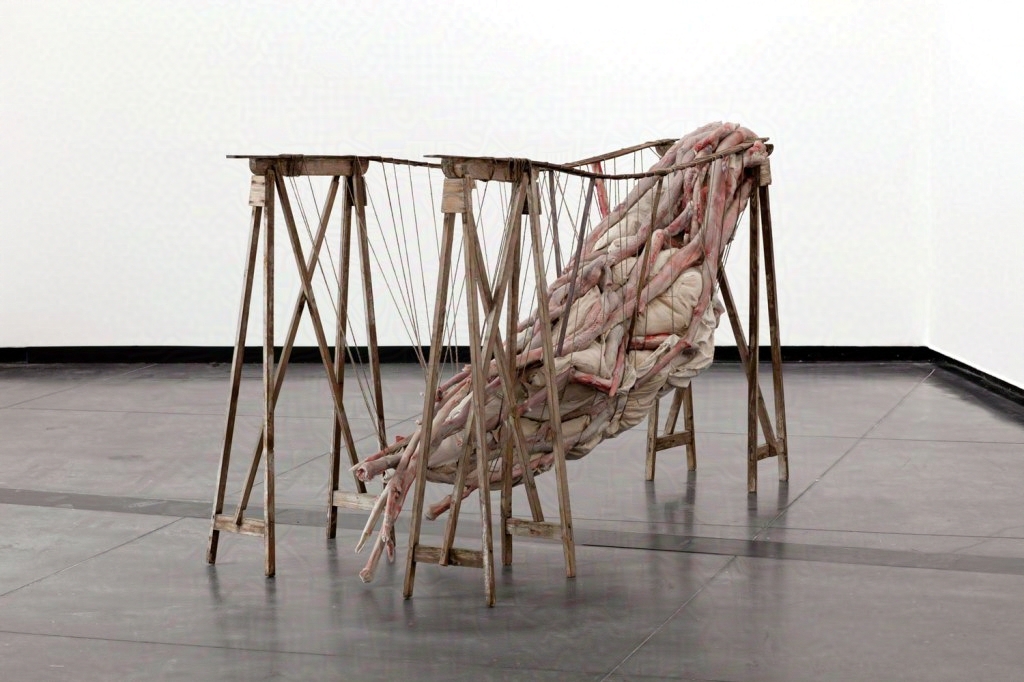
De Bruyckere’s exhibition We Are All Flesh is full of bodies that are hung, stitched, wrapped and partially flayed which she describes (ACCA_Melbourne 2012) as being “about the surface and what’s going on inside”. These works turn skin into a thin and unreliable border. If bad faith relies on a fantasy of a safe inner self that never really has to be tested in the world, these sculptures destroy that fantasy. What is supposed to protect the interior is split open so there is no clean separation between inside and outside. Read through Sartre, this feels like a visual response to bad faith: insides dragged out to the surface in a way that is messy and awkward, with intestines and sinew on full display. Her sculptural language of wounded flesh offers a way of being with others that accepts vulnerability instead of hiding it. Her work Inside Me III everts the figure, exposing intestines and a core of flesh that is held within an external skeleton that both cushions and constrains it. By literalising interiority, the work makes vulnerability tangible and reveals the body’s internal workings while withholding the face, so the exposed flesh stands in for emotions and states that are usually kept hidden. This invites viewers to project their own feelings and to question what they conceal in their own lives. Inside Me III uses the everted body as a metaphor for the exposure of inner states and the precariousness of being human, similar to how European artists such as Francis Bacon and Alberto Giacometti use the human figure to reflect trauma, mortality and existential fragility. Although Bacon is not usually framed directly through Sartre’s language of bad faith, his stated desire (Sylvester and Bacon 1975:41) to “paint the fact” and strip away “illustration” can be read as his refusal to engage in the polite illusions that sustain self-deception. Bacon’s distorted bodies echo Sartre’s insistence that we cannot hide behind fixed images of ourselves without lying to our own freedom. His work overlaps strongly with de Bruyckere’s, both artists rejecting the classical coherent body. Bacon’s figures appear twisted, dissolved or flayed through paint, while de Bruyckere’s bodies are folded, fragmented or hybridised. Bacon achieves this through painterly distortion that makes flesh appear psychologically ruptured, while de Bruyckere literalises rupture by everting the body itself. In both practices, the interior is no longer hidden but becomes the primary subject. De Bruyckere’s work therefore parallels Sartre’s concept of freedom and asks the viewer to consider the artist’s invitation to expose and share themselves.
Francis Bacon (1909-1992), Head VI, 1949, 93.2 x 76.5cm, Oil on canvas. (Wikipedia 2013 updated 2026)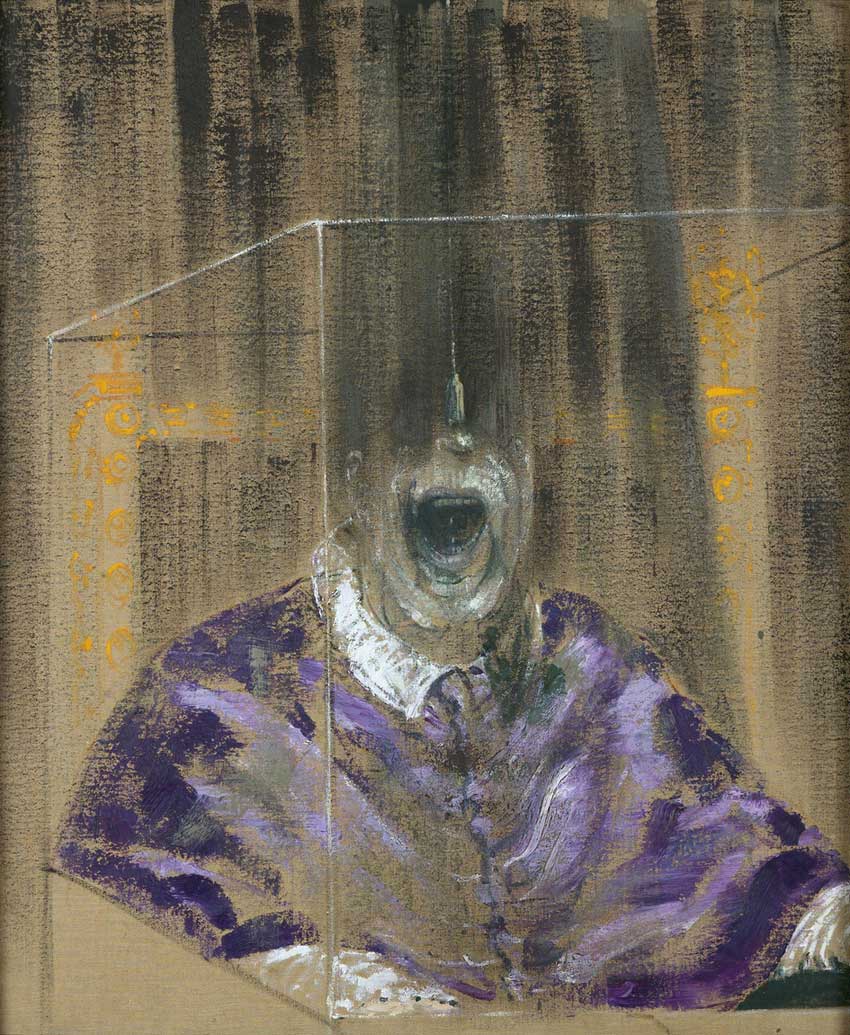
This is the point where these concepts intersect with my own work. In my practice I am also aiming for that invitation to look within, exploring the contradictions between inner state and outer behaviour and how they remain visible rather than being easily smoothed over. If, as Sartre suggests, “there is no love other than the deeds of love” (Sartre and ebrary 2003:37), then there is also no shared pain without some outward form or language through which it appears. De Bruyckere’s work and my own paintings and sculptures intersect at this junction, where the invisible interior insists on becoming visible, even if distorted, ambiguous or at odds with itself. In The Imaginary, Sartre describes the image (Sartre and Elkaïm-Sartre 2004:182–183) as a “consciousness of something as absent”. An image does not simply mirror a visible reality; it holds together what is present on the surface and what is missing or unseen. Together, these parallels demonstrate how de Bruyckere’s work explores the same themes as Sartre’s writing and, although not a philosopher, her sculptures offer a powerful visual illustration of his ideas about freedom, bad faith and the exposure of the inner self.
Eric, Duplex (front view), 2026, 550x665x50mms, Back‑to‑back double‑sided painting: rabbit‑skin–sized canvas, charcoal, oil paint, woollen yarn, wire, rusted nail, double‑sided tape, rusted and new bulldog clips, reclaimed wooden frame.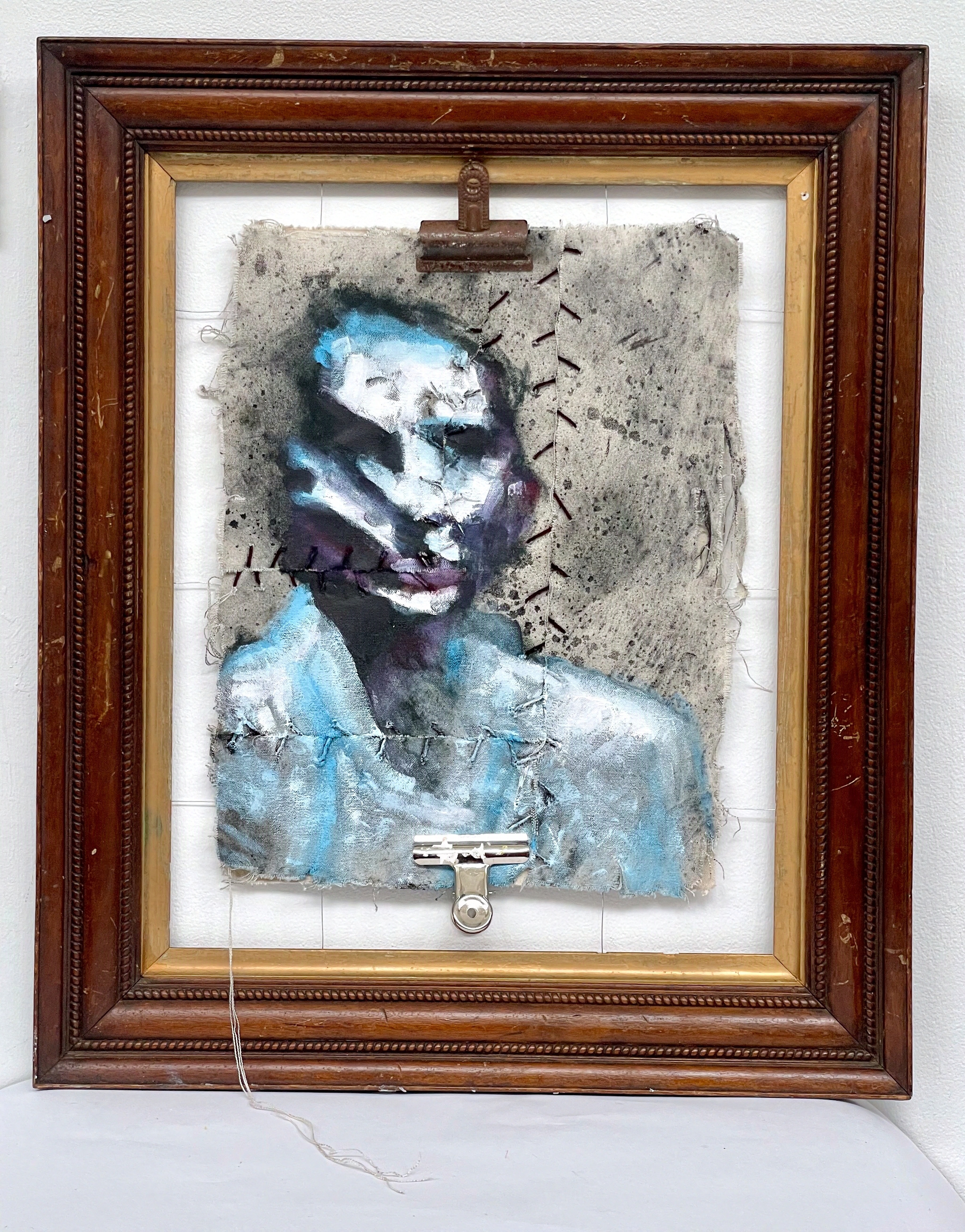
Can freedom and bad faith be explored through the visual arts? The dialogue between Sartre’s writing and de Bruyckere’s work suggests they can. Sartre’s claims (Sartre et al. 2007:20–22,37) that “existence precedes essence”, that there is “no love other than the deeds of love”, and “no genius other than that which is expressed in works of art” suggest that our inner states only gain meaning through the actions and images that express them, and that bad faith occurs when we deny this link and pretend our actions do not belong to us. De Bruyckere’s Inside Me III can be read as a physical refusal of that denial. Her everted, suspended bodies collapse the distinction between inside and outside, making vulnerability impossible to hide and turning flesh into a shared language of care, pain and fear. These works visualise the tension between who we think we are and what we do in the world. My own practice, with its focus on inner conflict and outward behaviour, works in a similar space by presenting figures whose bodies and gestures betray their inner states. Together, these examples show that visual art can stage Sartre’s questions about freedom, responsibility and bad faith, using the surface of the artwork or the eversion of the figure to bring the gap between our inner lives and our actions into view in a way that cannot be easily ignored.
ACCA_Melbourne (2012) ‘Sculpture: Berlinde De Bruyckere Interview at ACCA, We are all Flesh 2012’ Australian Centre for Contemporary Art, YouTube website, accessed 08/04/2026. https://youtu.be/ffzINEejOs0?si=VzOKcowmlyp-QQce
Bunyan DM (2012) Review: ‘Berlinde De Bruyckere: We are all Flesh’ at the Australian Centre for Contemporary Art (ACCA), Melbourne, Artblart website, accessed 08/04/2026. https://artblart.com/tag/berlinde-de-bruyckere-inside-me-iii/
Sartre J-P and ebrary ICP (2003) Being and nothingness : an essay on phenomenological ontology, 2nd edn, Routledge, Taylor & Francis Group, London.
Sartre J-P and Elkaïm-Sartre A (2004) The imaginary : a phenomenological psychology of the imagination, 1st edn, Routledge, doi:10.4324/9780203644102, London.
Sartre J-P, Macomber C, Cohen-Solal A, Elkaïm-Sartre A and John K (2007) Existentialism Is a Humanism, 1 edn, Yale University Press, doi:10.2307/j.ctv15vwkgx, New Haven.
Sylvester D and Bacon F (1975) Interviews with Francis Bacon, Thames and Hudson, London.
Wikipedia (Wikipedia_contributors) (2013 updated 2026) Head VI, Wikipedia website, accessed 08/04/2026. https://en.wikipedia.org/wiki/Head_VI